
Tier: SMT100: Core Principles
Related: SMT200: Systems · SMT300: Research
SMT106: The Pipeline Didn’t Change. The Material Did
The node graph is not a sandbox. It is a three-stage light transport model: capture, grade, output.
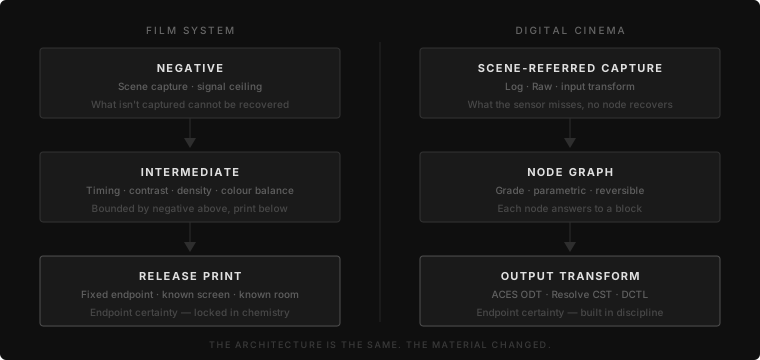
When you look at a node graph in DaVinci Resolve, you are not looking at a correction chain. You are looking at a light transport model: a reconstruction of a journey that existed long before digital cinema had a name. The journey was always the same. Light leaves a scene. Something captures it. Something interprets it. Something presents it to an audience. Three stages. Three contracts. Three distinct jobs.
Film didn’t design this. Physics did.
The Three Blocks – In Film
Block 1 – The Negative
The negative records what was there. It doesn’t interpret. It doesn’t editorialize. It sets the signal ceiling, the noise floor, and the latitude available downstream. What the negative doesn’t capture, nothing downstream can recover. This is SMT101 in chemical form.
Block 2 – The Intermediate
Timing and printing. This is where interpretation happens: contrast, density, colour balance, the emotional temperature of the image. The intermediate is bounded by what the negative captured and by what the print stock can hold. It is not a sandbox. It is a constrained creative space with physics on both sides.
Block 3 – The Release Print
The release print is the delivery. It has fixed photochemical behaviour. The projectionist threads it. The screen has a known gain. The room is dark. The colourist knew, with certainty, what the audience would see. Not approximately. Not hopefully. Certainly.
The phrase that defines this block: print, not a display. Not an aesthetic preference. A statement about endpoint certainty. The print was the endpoint. Locked in chemistry.
The Three Blocks – In Digital Cinema
The blocks didn’t go anywhere. The materials changed.
Block 1 – Scene-Referred Capture
Log footage, raw, scene-referred colour science. Same job as the negative. Records what was there. Sets the ceiling. What the sensor doesn’t capture, no node can invent. The input transform normalises the signal into a known working space. This is not a creative decision. It is a contract.
Block 2 – The Grade
The node graph. Same job as the intermediate, now executed in software. The parametric era has given us something film never had: the ability to back off the effect without stacking compensatory nodes. The blocks are now modular, adjustable, reversible. The structure of film. The flexibility of software.
Block 3 – The Output Transform
This is where the pipeline earns its rigour or reveals its absence. The output transform constructs the endpoint deliberately: the job the release print did through chemistry, now done through mathematics. It is not a look. It is not optional. It is the third block.
Whether you are using an ACES ODT, a Resolve Colour Space Transform, or a DCTL like JP2499: you are in the third block. The tool is different. The job is the same: construct a fixed, known endpoint for a specific display system.
The 2383 LUT is a representation of this third block in baked form. It assumes a specific input state. Violate that assumption and you haven’t used the tool wrong. You’ve broken the contract between stages.
What Changed – And What Didn’t
Film locked the three blocks in physics. You couldn’t back off the negative. You couldn’t adjust the print stock mid-job. The constraints were the system.
The LUT era effectively collapsed all three blocks into a single baked artifact. Convenient. Fast. And it quietly destroyed block independence. You lost the ability to work the stages separately.
The parametric era restored the architecture. The blocks are back. Modular, addressable, reversible. But now the constraint has to come from discipline, not from chemistry. The physics won’t enforce it for you.
If you think the node graph is a sandbox (unlimited, unconstrained, open-ended), you have lost the architecture. You are compensating downstream for upstream mistakes. You are mixing before you’ve tracked. You are mastering before you’ve mixed.
The Floor
The core of the system has never really changed. How we manipulate it has.
Understand the three blocks. Know which one each node belongs to. Treat the output transform as the endpoint it is: fixed, known, deliberate. Engineer to it the way a print was engineered to a screen.
The pipeline didn’t change. The material did.
Distillation
The node graph is like a three-stage light transport model: capture, grade, output. Film enforced these stages in chemistry. Digital requires you to enforce them in discipline. Each stage has a distinct job and a contract with the stages adjacent to it. Violate the contract (apply the output transform without a correct input state, collapse all three into a single pass) and endpoint certainty dissolves. The parametric era restored block independence that the LUT era had collapsed. The architecture is the same as it was in 1950. The material is different. The discipline required is the same.
Related Concepts
Principles
SMT101: Exposure Is Structural
SMT102: LUTs Are Constraint Systems
SMT103: Neutrality Preserves Narrative Control
SMT105: Robust System Design in Colour